Vivero de Tebanca A.C.
Los Tuxtlas, Veracruz. México.

Contacto
English
Vivero de Tebanca A.C.Bringing water back to the Los Tuxtlas rainfuorest, one spring at a time.
Los Tuxtlas, Veracruz · Mexico · Since 1998
231 water springs restored · 8 arboretums · 130+ landowning families · 28 years
Where we work
Los Tuxtlas sits on the Gulf coast of Veracruz, in southeastern Mexico. It holds the northernmost tropical evergreen rainforest in the Americas — a place where species of northern and southern origin meet, producing exceptional biodiversity.
It is also one of the most damaged forests in the country. Between 1976 and 1986 the region lost forest at a rate of over 4% a year, one of the gravest episodes of biodiversity loss in Mexican environmental history. Between 1980 and 2011 the Reserve lost 30,074 hectares of forest cover — almost a fifth of its surface. In 1995, induced pasture overtook forest as the dominant land use.
The Los Tuxtlas Biosphere Reserve was decreed in 1998. It covers 155,122 hectares across eight municipalities. Roughly half of it — 78,970 hectares — is cattle pasture today. The Reserve is administered by a professional staff of around ten people.
Our work begins where that sentence ends.
What we do
Vivero de Tebanca is a Mexican non-profit association working in community-based ecological restoration and agroforestry. We focus on one thing: water springs and their groundwater recharge zones.
Springs are where the forest and the community meet. They supply drinking water to rural settlements, they feed the streams that reach Lake Catemaco, and they are among the most valuable services a tropical rainforest provides. When the forest around a spring is cleared for pasture, the spring dries.
Our method has not changed in nearly thirty years.
We collect the seed. Our nursery staff walk the region collecting seed and seedlings from more than eighty native species. Seed trees are selected for quality and recorded with their GPS position. We know the phenology of each species, and collection runs through the year.
We raise the plants. The nursery produces around 25,000 plants a year and can reach 45,000 with additional staff. In better-funded years it has exceeded 80,000. We have deliberately kept production at a level where we can sustain a real relationship with every family we work with, because that relationship — not the planting technique — is what keeps the trees alive.
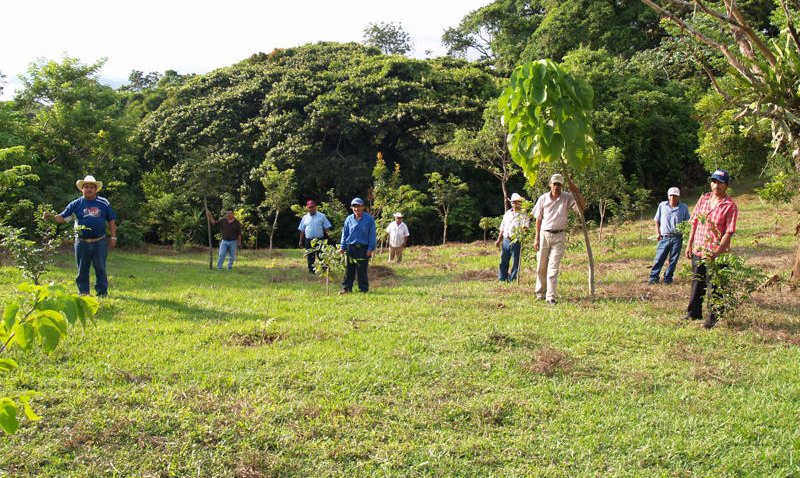
We plant with the landowner. The plants are given at no cost to the farming families who agree to restore the spring on their own parcel. They provide the land and the labour; we provide the plants, technical guidance and follow-up. Planting takes place in June and July so the seedlings establish during the rainy season.
We plant for the long term. Alongside the native canopy we establish coffee (Coffea arabica and C. canephora) and allspice (Pimenta dioica) in the growing shade. This is the heart of the model: the landowner earns from the trees, and therefore has a reason to keep them standing. By year seven, robusta coffee is being harvested under mature shade.
Survival is above 75% in the first year, counted in the field by our foresters.
Land, consent and continuity
Every site we work on is privately or communally held by the farmer who works it. Since 2005 we have signed a written agreement with each participating family, in which they commit to conserving the native species and retain the right to harvest timber species.
That paper trail now runs twenty-one years. Every restored spring is GPS-mapped and recorded under the name of the individual parcel holder.
This is not a detail of administration. It is the reason the work has lasted: the person who cares for the tree owns the ground it stands in. At least fifteen parcels have moved out of cattle ranching altogether.
What the results look like
"It is remarkable to see that within a period of around ten years, a spring that was practically dry becomes a permanently flowing source of water again, thanks to a vegetation cover that in that same period exceeds ten metres in height and forms a continuous canopy."
Julia Carabias Lillo, Mexico's Minister of the Environment, Natural Resources and Fisheries (1994–2000), after visiting the project
We can show the same ground at seven, twelve, fourteen and thirty years of restoration. The first communal spring we restored, in the ejido of Tebanca, still contributes to the community's drinking water supply.
In 2025, sixty farmers who have restored springs with us were interviewed as part of an independent study. Forty reported that the water now holds steady; eleven reported that flow had increased. Thirty wanted to expand the area they had restored. None said they wanted to stop.
"It used to be pasture, and once you plant trees there's more shade, and it gives more water, and it doesn't dry up. There were times when the water ran out. Not now."
—Julia, participating farmer, Los Tuxtlas
History
The project began with a drought. Through the 1990s, streams that had supplied water to communities in Los Tuxtlas began to fail; the dry season of 1996 was the turning point. In 1998, Antonio Azuela Rivera (1918–2017) obtained the first 306 trees from the government of Veracruz to reforest the spring at the ejido of Tebanca. The Biosphere Reserve was decreed the same year.
He used to say that the project could only bear fruit beyond the lives of the people who started it. He died in 2017. The springs he planted are still running.
The association was formally constituted in 2005. In 2002, a master's thesis in Ecological Restoration at UNAM, supervised by Dr Rodolfo Dirzo, was carried out at our nursery and produced the selection of native species we still work from. In 2008 we delivered the spring restoration component of the Integrated Ecosystem Management project (GEF / UNDP / CONANP).
Research and partnerships
Our work is studied, not only carried out.
The Lincoln Institute of Land Policy published a full case study on the project in 2026, examining the visibility and recognition of ecosystem restoration in Los Tuxtlas. We host social service students from the National Autonomous University of Mexico (UNAM) and the Universidad de las Américas Puebla, and have a longstanding agreement with the Universidad Veracruzana. In 2024 we hosted a research stay by a Harvard University graduate student under the Peter Walker & Partners fellowship. In 2021 we conducted a perceptions study for the World Resources Institute.
The project has been written up in Tapuya: Latin American Science, Technology and Society, in the Revista Latinoamericana de Estudios Rurales, and by the Lincoln Institute's International Land Conservation Network.
Topote de Acahual
Topote de Acahual is the artistic and educational branch of Vivero de Tebanca.
Topote is the fish with which visitors to the rainforest are welcomed — a symbol of hospitality and biodiversity. Acahual, in Nahuatl, is land at rest.
Founded in 2019, it is a cultural community of artists, foresters, biologists, teachers and residents of the region, working on collective narratives of regeneration through walking, mapping, sound, printmaking, writing and cooking. It runs a laboratory, an experimental forest school, and an artist residency programme.
In 2025 Topote was selected from 116 applications for a collective research residency at a.pass (Advanced Performance and Scenography Studies) in Brussels. It has exhibited at El Colegio de México, published in LA ESCUELA___ Journal, and works with the support of Fundación Jumex Arte Contemporáneo.
Who we are
Seven people are employed by the nursery year-round, rising with the planting season. Our team combines forestry technicians, nursery workers, researchers and artists.
Work with us
We welcome partnerships with organisations working on reforestation, watershed protection, biodiversity and rural livelihoods, and we are open to conversations about supporting specific planting seasons.
If you would like to visit, we mean it. The nursery is at the edge of Lake Catemaco and the door is open.
Vivero de Tebanca A.C. Tebanca, Catemaco, Veracruz, Mexico viverodetebanca@gmail.com
azueladelacueva@gmail.com
viverodetebanca.com · Instagram @vivero.de.tebanca
WE NEED YOU HELP!

safe donation by donorbox.com